
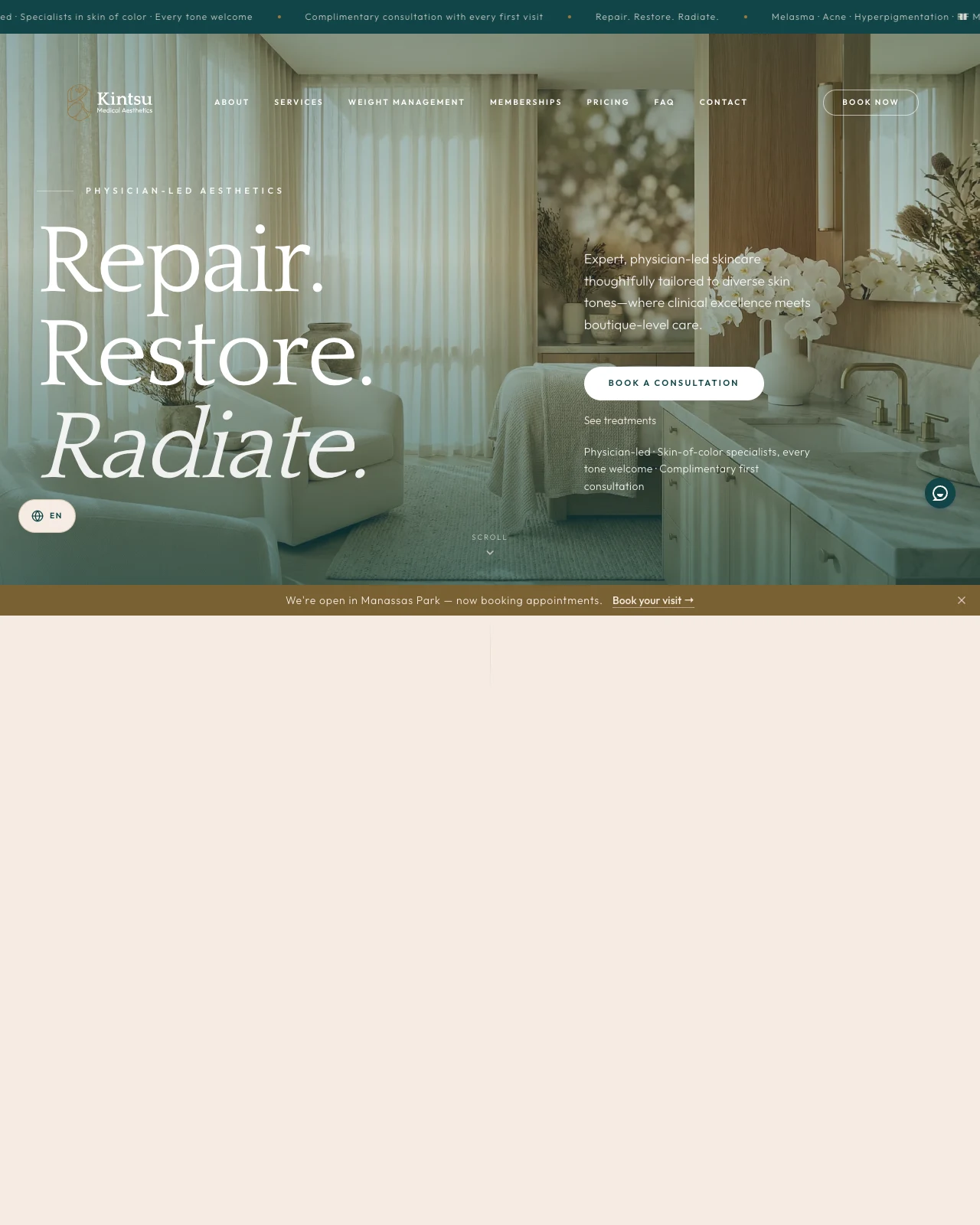
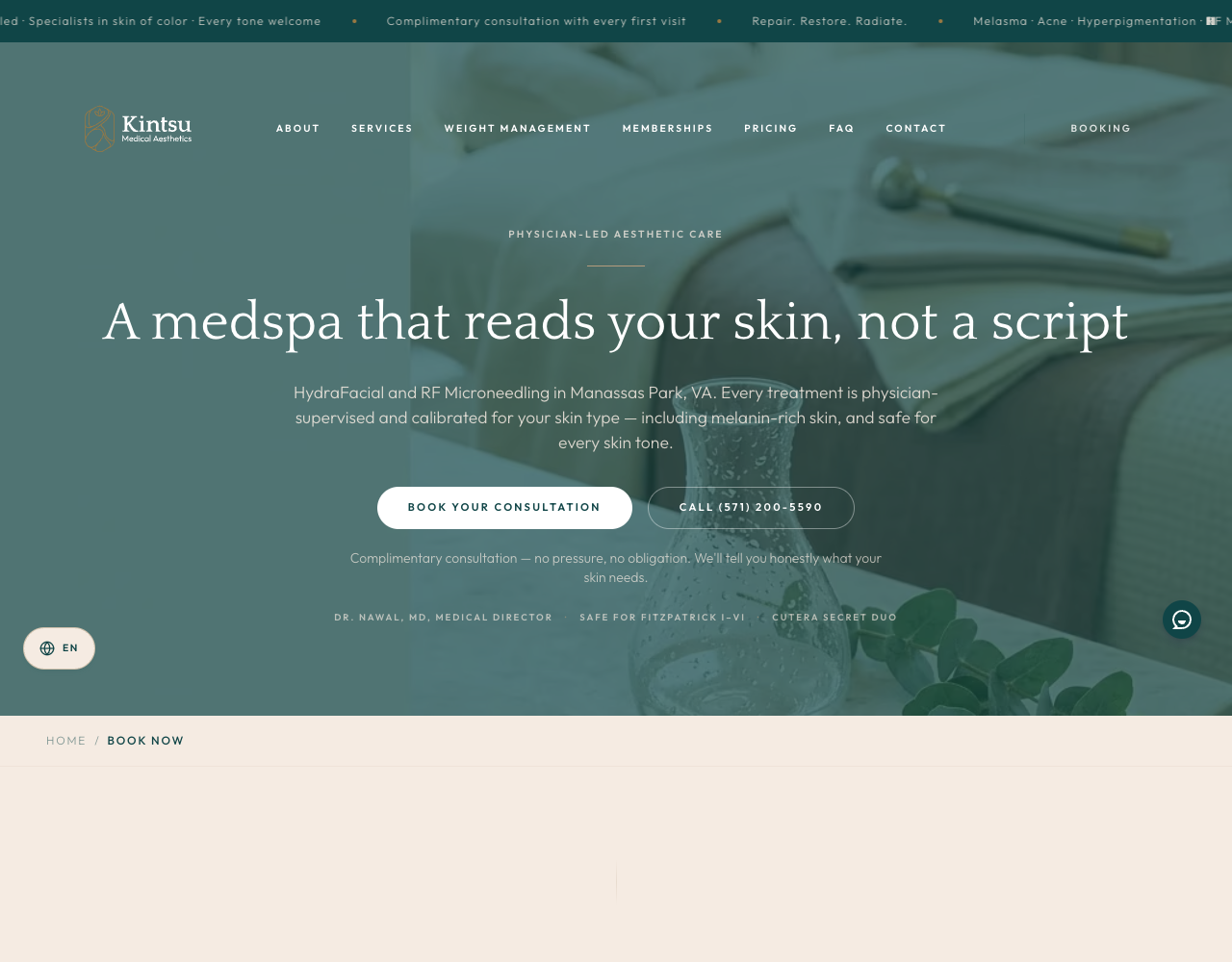
A lease, an opening date, and nothing online
Kintsu's physician-owner had a signed lease, an opening date, and nothing online. She needed patients to understand the practice quickly, find it from a phone search, and book without calling.
The work also carried three constraints from day one. Kintsu is built for Fitzpatrick III to VI skin, the medium-to-deep skin tones most skin tools handle badly. The front desk already used Zenoti. And a supplier price floor, the lowest price the supplier allows, had to hold on every page and every promotion.
Four vendors or one team
The owner had two realistic options. She could hire four vendors, an agency for brand, a search firm, a freelancer for the booking plumbing, and nobody at all for daily operations. Or she could hand the whole scope to one team.
She chose one team. That meant one plan, one approval path, and one person accountable when brand, website, search, booking, and advertising had to agree with each other.
The six parts we built
The public website was live before the practice opened in late May 2026. The grand-opening event followed on June 25. Online booking went live on July 12, and 88 local pages went live on September 2.
November 2025 to September 2026
From nothing online to patients booking themselves
Three moments an owner feels, in the order they arrived.
May 22, 2026
The doors open with the website already up
Pricing, treatments and the grand opening were all on the site before the first guest walked in.
July 12, 2026
Patients book themselves, no phone call needed
Real availability from the practice software, on the practice's own booking page.
September 2, 2026
88 pages, one per treatment in every nearby town
Eleven treatment lines across eight towns in and around Prince William County.
That sequence matters more than a launch-day screenshot. The site could explain the practice, the booking path could reach the software the front desk already used, and the search foundation could cover nearby towns without copying one template 88 times.
- Brand system, live. A clear story, voice rules, colors, and type built into the site, so future pages have something concrete to meet.
- Website, live. A fast marketing site with financing information, protected pricing language, and a booking path.
- Local search, live. 88 pages covering 11 treatments across eight nearby towns. Rankings and traffic aren't measured yet.
- Online booking, live. Patients book on Kintsu's site and the appointment lands in Zenoti, which stays the one place appointments live.
- Skin-consultation tool, private pilot. Built for Fitzpatrick III to VI skin and designed to keep no photos. It isn't open to patients while legal and medical review finishes.
- Advertising controls, live. The system can pause an ad or cut a budget inside a $1,000 monthly cap. It can't raise a budget or change ad copy.
How the work stayed manageable for a small owner
One way of working, on every job
How we keep you safe from our own mistakes
Four promises, three checks between them, and a person on the last one.
Promise one
The plan is written down first
We agree what gets built, and how it should behave, before anyone starts building.
Like drawings everyone signs off before a single wall goes up.
Promise two
The work is done to that plan
Whoever builds it works from the written plan, not from memory.
The builder works from the drawings, not from what they remember.
Promise three
Someone else checks the work
A second person, who did not do the work, goes over it fresh.
A second set of eyes, the way a different mechanic checks the repair.
Promise four
A person decides what goes live
Our automation can suggest a change. It can never publish one.
Like a proof you sign off before anything goes to print.
The same four promises cover your brand, your website, your search visibility, your booking and your advertising. We only build something new when the ordinary way will not do the job. On this project, five of six tools we considered were never built.
Nothing reaches your customers without a human saying yes.
The method is simple. We write the rules down, build against them, check the work with a fresh pair of eyes, and keep a person in the approval loop.
That meant Kintsu didn't have to become a software company to use the work. The owner sets the limits and we explain what changed. Software handles the repetitive checks, but it can't quietly publish a page, raise ad spend, or write sensitive changes into Zenoti.
One rule from each part of the job
Your rules, written where software cannot argue
A rule kept in someone's head holds until that person is busy. A rule written down holds on the busiest day.
Website
No offer containing a HydraFacial is ever published below $149.99.
It cannot be waived by any instruction typed into a chat window, and every piece of copy is checked against it before it goes out.Brand voice
A banned-word list is checked on every post, and a clear miss stops the batch.
No exclamation points, no caps lock, no stacked emoji. An off-voice post is stopped before anyone sees it.Practice software
Nothing writes to Kintsu's Zenoti scheduling without a person confirming it.
A change nobody has read cannot be checked, and an automatic retry can double-book a patient.Your price floors, your brand promises and your patient calendar stay safe from a bad day, a new hire, or a clever prompt.
Rules like these are written at the start of a project, and every later change is checked against them.
In their words
Kintsu's physician-owner, on working with the team:
"I have no idea how AI works, and the best thing about the Simple Cortex team is that I don't need to. Things just work!"
What we got wrong, and who caught it
Three we caught ourselves
We find our own mistakes first
Every row is a real mistake on this project, with the check that found it.
Five placeholder reviews in a draft of the site
Our own sweep of the draft, the day after they went in.
They were dated before the practice had opened, so they could not have been real, and no fabricated rating has appeared on the site since.
24 privacy problems in the plans for online booking
Three reviewers reading the same plans at the same time.
The audit read the specification, the prototype and the hosting plan together, and found treatment names traveling inside a calendar link.
An ad platform quietly paused one of your ads
We read the ad account back after every automatic change.
Nobody asked for the pause. The read-back is the only reason we knew, because it fetches the account again and compares it with what we intended.
Two of the three were ours.
Some of this went wrong before a patient could see it. That's the point of checking.
- Five testimonials that weren't real. A test build of the site carried five patient reviews dated before the practice had patients, and our own brand review caught them within 24 hours. The brand write-up has the full account.
- Town pages that read alike. A first batch of local-page drafts came back 52% to 85% similar to each other. Our own similarity check caught them before publishing. Near-copy pages are what Google treats as spam, so publishing them would have put the whole local-search effort at risk. Every town page now has to carry its own writing before it can go live.
- Six weeks on the wrong photo step. The skin-consultation tool served an older single-photo capture for about six weeks. An audit of what the live tool was actually running found it, and we fixed it on August 20, 2026. It meant a real improvement existed in the code and nowhere a user could feel it. A kill switch and a check on what production is running now cover that gap.
- A weekly job pointed at a sleeping laptop. Between July 25 and August 3, 2026, a weekly report ran on the only machine available, a personal laptop, and ran successfully once in that window. We found it while writing down how the automation runs. It meant a check the owner assumed was happening mostly wasn't. The trap is documented in the job itself and a separate check now confirms each run finished.
Other ideas died instead of shipping. We killed a Groupon voucher redeemed straight into Zenoti without writing a line of code, threw away a cheaper batch of town-page drafts before publishing, and deleted a monitoring service that duplicated checks we already had.
Ten ideas, one project
We kill bad ideas before you pay for them
Every one of them was stopped at our desk. None reached a patient.
What we can prove today
The scoreboard, both sides
Every number we can back up, and the ones we cannot yet
Three things are counted today. Three are still blank, and we say which.
88 local pages, live
Eleven treatment lines across eight nearby towns, counted page by page.
They went live on September 2, 2026. The count comes from the pages themselves, not from a plan of how many there were meant to be.
24 privacy problems in the booking plans
Three reviewers reading the same plans at the same time.
Every one was dealt with before online booking opened on July 12, 2026. The worst of them was a calendar invitation carrying the treatment name.
$1,994 of advertising in August 2026
The ad accounts themselves, read back after the month closed.
It came to $76.70 for each click on a booking button, against a $15 target we set. Missing a target by five times is why the daily budget was cut on September 1, 2026.
Bookings taken through the website
Waiting on the booking software, which has been taking them since July 12, 2026. A click on a booking button is not a booked appointment, and we will not offer one as a stand-in for the other.
Visits and search views the 88 pages bring in
Waiting on the analytics and search accounts. The pages went live on September 2, 2026, which is not yet enough of a run to say anything honest about.
Google reviews, against 25 by August 31, 2026
A target set with the owner, not a result. It stays on this side until the review count is in front of us.
You get the numbers as they arrive, whatever they say, rather than a page of confident figures nobody can source.
- Delivery fact. The website was live before opening, about eight weeks from project start.
- Delivery fact. 88 local pages live across 11 treatments and eight towns, from September 2, 2026.
- Delivery fact. 24 privacy problems found and dealt with before booking launch.
- Delivery fact. Online booking connected to Zenoti since July 12, 2026.
- Delivery fact. A $1,000 monthly advertising cap enforced from August 4, 2026.
The first scorecard, due December 2026, measures organic sessions, search impressions and clicks, Zenoti bookings, conversion rate, and review growth.
Is this a fit?
This model fits an owner with several disconnected problems, an outdated site, manual booking, weak local visibility, or repetitive reporting, who wants one practical plan across all of them.
It's a poor fit if you only need a logo or a cheap one-off website with no integration work. It works best when you can approve changes quickly and share the data needed to measure them.