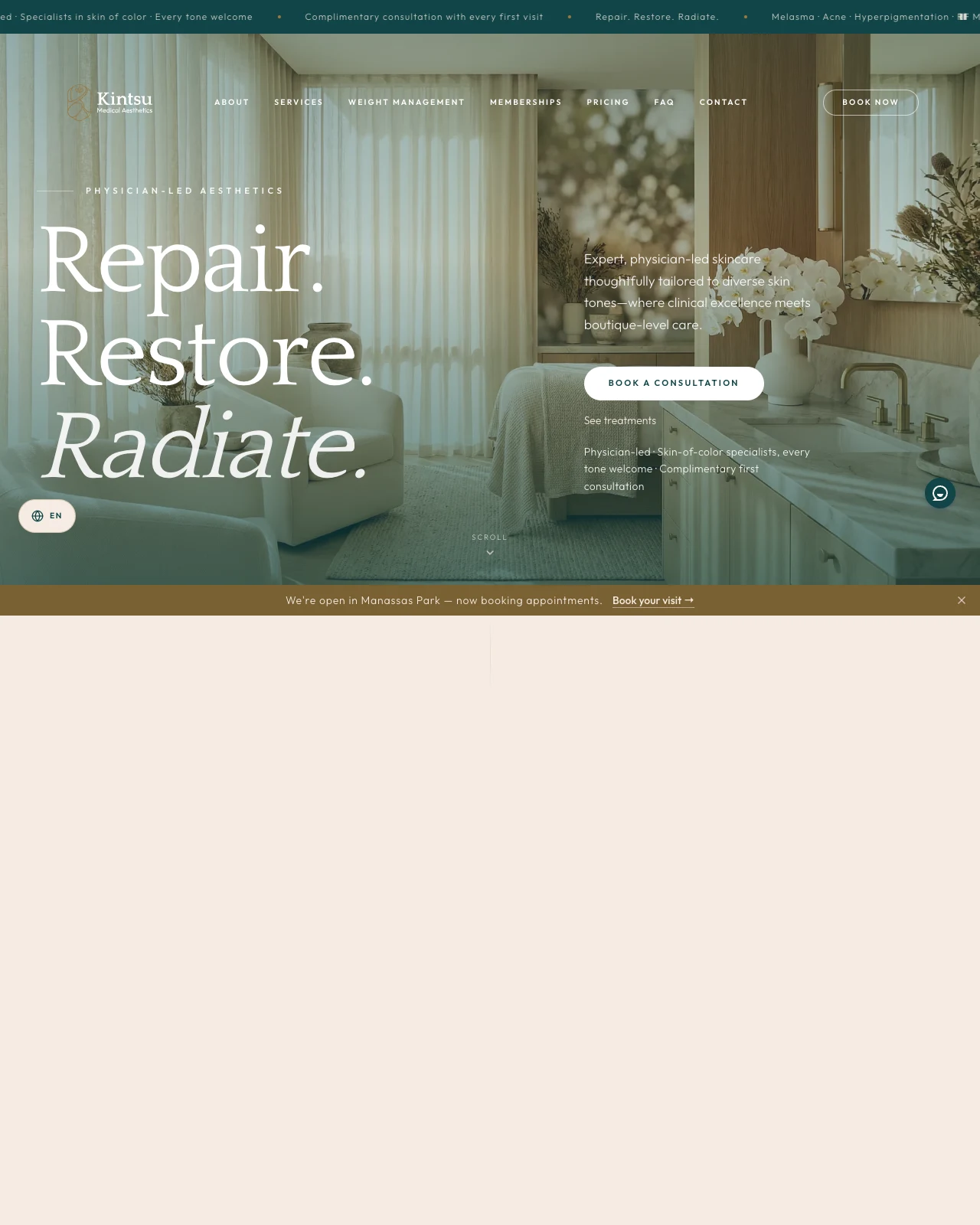


Opening day was fixed, the website wasn't
Kintsu needed patients to trust a new practice before the doors opened. A brochure site wouldn't do that on its own.
The site also had to guide visitors toward booking and reach Zenoti. And it had to hold that supplier price floor on every page and every promotion.
Build once for launch, or build to be changed
The owner had a real choice about what the site was for. A launch-day site is cheaper, and it can be handed over and left alone. A site that changes every week costs more up front and needs a release process behind it.
She chose the second. Prices, treatments, and promotions move in this business, so we built for edits made in the middle of a working day.
What went live
May to September 2026
Your front door opens before your doors do
Six things a patient can touch, in the order they arrived. Drag the marker, or step it with the arrow keys.
May 14, 2026
A front door, before there was a front door
An Opening Soon page went up while the practice was still being fitted out, so anyone searching could already find it.
June 14, 2026
One price list, in both languages
English and Spanish had drifted apart. Both now read from one source, so a price changes once.
July 12, 2026
Patients book themselves, straight into your calendar
Booking goes into Kintsu’s Zenoti scheduling. It opened without any promotion, to prove itself on real patients first.
July 22, 2026
A way to pay for the bigger treatments
Any treatment priced at $800 or more carries a financing link with the amount already filled in.
September 2, 2026
Faster pages, and the security findings closed
An outside security test on August 26, 2026 produced findings. Every one of them was closed on the day the speed work landed.
September 3, 2026
A clearer path to booking
Twenty-six scattered booking prompts became three deliberate ones, placed where people decide, with accessibility fixes on nineteen pages.
The people who find you can look and book their own way, without waiting for anyone to call them back.
The public site went live before opening. Online booking followed as a quiet launch on July 12, 2026, so it could be tested with real use before anyone promoted it.
- A marketing website built for a weak phone connection.
- A booking path that sends appointments into Zenoti.
- Financing information for larger treatments.
- A rule that stops any HydraFacial offer from appearing below the $149.99 supplier floor.
- Security hardening and a release process that checks the live site after publishing.
The rule, word for word
A price you are contracted to hold, that nothing can undercut
Not our summary of it. The clause.
No offer containing a HydraFacial may ever be advertised, proposed, or published below $149.99.
It cannot be waived by any instruction typed into a chat window.
- Where it comes from
- A clause in the practice’s supplier contract, not a preference we set.
- Where it lives
- In the house rules the software follows, in these words, not in a note to a writer.
- What holds it
- A check every piece of copy passes before it publishes. A price under the floor stops there.
A rushed promotion or a stand-in writer cannot publish a price your supplier contract forbids you to publish.
In their words
Kintsu's physician-owner, on the launch:
"Being a new medspa in the area was daunting, but the website Simple Cortex made for us made me believe we could do this."
Keeping the site safe to change on a Tuesday
Every time your site changes
Change a price on a Tuesday afternoon, safely
Three things that could go wrong when a live clinic site is updated, and what stops each one.
Step one
You change it once, not twice
Every word and price lives in one place, in English and Spanish together. There is no second copy to forget, so the two languages cannot end up saying different numbers.
Step two
Nothing goes out half finished
A new update never interrupts one already going out. Updates wait in line, each page is put together in full first, and your site keeps serving the old pages until the new ones are all ready.
Step three
A broken page never reaches a patient
After it goes up, every page is opened and checked. Anything that does not check out goes back before a visitor sees it, and that check is what caught a speed fix that only looked finished.
The attempt we threw away
The setting almost every site is left on
It cancels the update already going out when a new one arrives. On this site that killed the work part-way through and left half-built pages on a live clinic site, so we turned it off and made updates queue instead.
Turned off on purpose
You can change a price, fix a word, or add a whole page in the middle of a working day, and nobody visiting your site can tell it happened.
Updates queue instead of cancelling the one already in progress. Each release checks the live site before we call it done. The booking service retries failed requests, blocks abuse, and keeps patient details out of its logs.
Each of those is there so the owner can change the site without breaking it. She gets a site that can be maintained without guessing what a half-finished update changed.
What went wrong
- A speed fix that wasn't. A cached browser made a performance fix look finished when the live files hadn't changed at all. Measuring the published site, rather than the browser in front of us, caught it. It meant we nearly reported work as done that no visitor would ever have felt. We now re-measure the live site instead of trusting a convenient stand-in.
- A booking failure we couldn't fully prove. A visitor reported a booking that didn't go through. The request log that would have settled it had already been erased by an unrelated update. So we sent the vendor a records request instead of claiming certainty. The booking write-up has the full account.
What we can prove today
- Delivery fact. Public site live in about eight weeks, before opening day.
- Delivery fact. Online booking live since July 12, 2026.
- Delivery fact. 26 scattered booking prompts reduced to three deliberate ones.
- Measured. The mobile opening image dropped to about one-twelfth of its former data weight.
- Delivery fact. Security test findings closed on September 2, 2026.
The first scorecard, due December 2026, measures booking volume and conversion rate.
Is this a fit?
This approach fits an owner launching a new location, replacing a dated site, or connecting a marketing website to the system the team already uses.
It isn't a fit if you only need a few text edits or a low-cost template with no integration work. It works best when someone on your side can approve copy and pricing changes quickly.