
One address, eight towns
One Manassas Park address doesn't tell a search engine which towns a practice serves. Kintsu's patients drive in from Woodbridge, Gainesville, Centreville, and five other towns, and nothing on the site spoke to any of them.
The cheap version of this job is a city-page package: one template, 88 copies, the town name swapped in. Those are doorway pages, near-copy pages Google treats as spam, and buying them puts the whole site at risk.
So the useful question wasn't how many web addresses we could publish. It was whether a nearby patient gets a page that actually answers their local question.
The choice: 88 copies or 88 real pages
The owner had three ways to go. Buy the template package and publish 88 near-copies. Publish nothing and stay a single Manassas Park listing. Or pay for original writing on every single page.
The owner chose original writing, and we set the standard before a word was written. Every page needed at least 350 words of its own, and an automatic check blocked any two pages in the same treatment line that overlapped by more than 40%.
We tried a cheaper draft first anyway. It overlapped by 52% to 85%, so we threw all of it away before any of it went near the site.
The replacement splits the work into three passes: research, writing, and a separate fact-check by someone who didn't write the page. That costs more than swapping a town name. It also gives the owner a standard to hold us to.
How 88 town pages get written
A page for every town you serve, and none of them a copy
Three steps every page has to pass, and one whole attempt that did not.
Step one
We learn the town first
Each page is written about that town and that treatment, not about nowhere in particular.
Step two
A second set of eyes
Someone who did not write the page reads every claim in it. Nothing on this job marks its own homework.
Step three
A sameness test
At least 350 words of its own on every page, and no more than 40 percent overlap with any other page.
The attempt we threw away
The cheap first attempt
Drafted with cheaper writing tools. It passed every mechanical check and failed the sameness test, so none of it reached the live site.
Stopped on purpose
The sameness test runs as part of the build, so a new page cannot skip it.
How we built the pages
Eleven treatments, eight towns
A page for every treatment, in every town you serve
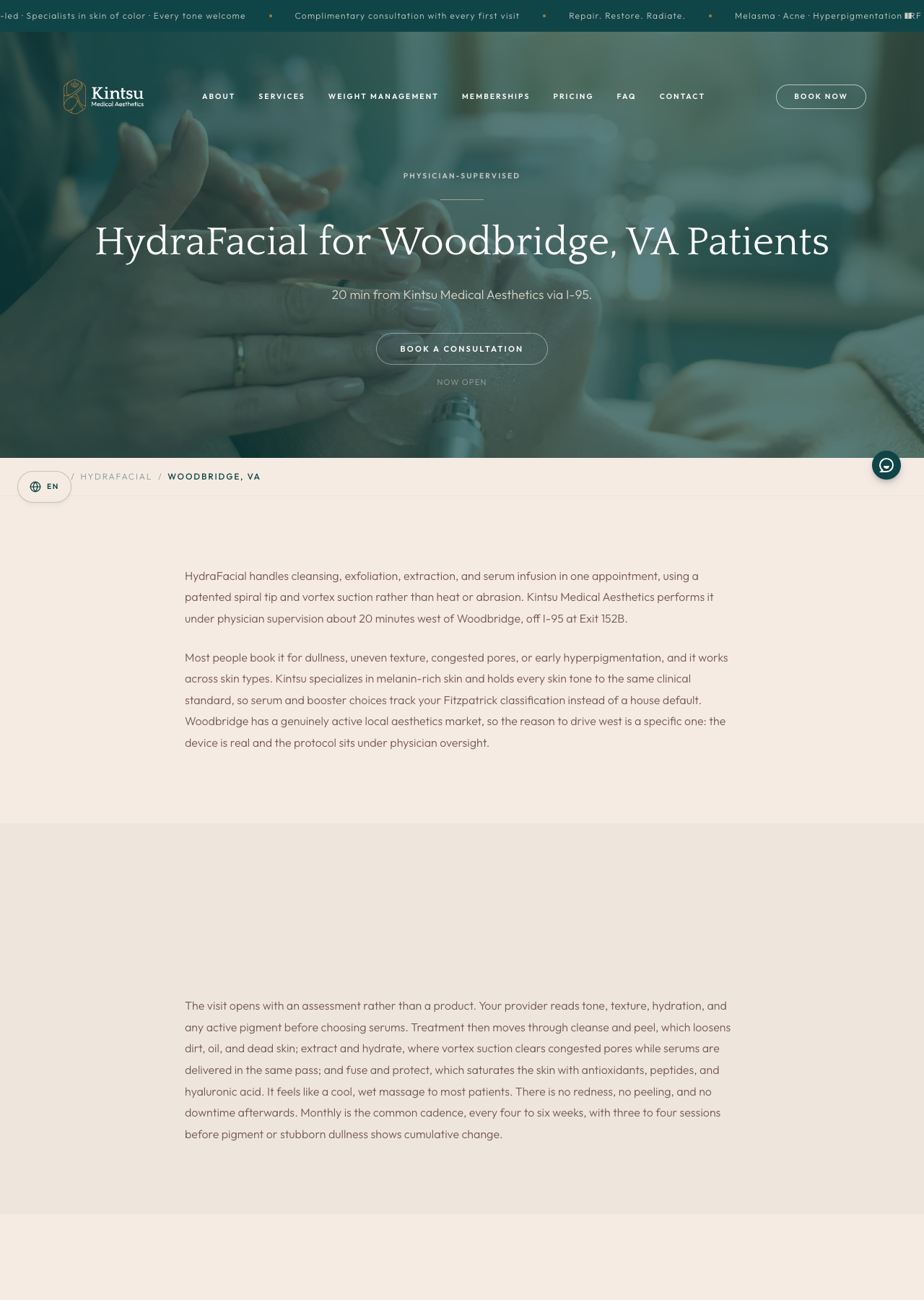
Someone in Woodbridge searching for a treatment finds a page written about Woodbridge, not one with the town name swapped in.
88 pages, written and live in one evening on September 2, 2026. Every one of them carries at least 350 words of its own before it is allowed to go live.
Eight towns
Eleven treatments and conditions
Sixteen town pages you already had moved onto the same design and kept their web addresses, so nothing you had already earned was lost.
- 11 treatments across eight towns, 88 pages in all.
- At least 350 words of original writing on every page.
- A 40% overlap limit between pages in the same treatment line.
- 16 older town pages carried forward without changing their web addresses.
- A search profile stating the address, phone, hours, and towns served, in a format search engines and AI answer tools can read.
That last item is what we mean by AEO. In plain English, it's making your business easy for AI search tools to understand and quote. It's a foundation for being found, not a promise that an assistant will mention you.
Being in the answer
Written so an assistant can read it out loud
Three plain things that put a practice inside the answers people now get from an app.
Your profile
Your address, phone, hours, map point, price range and the nine towns you serve, written where assistants read it.
Star ratings are deliberately left off. There are no real reviews yet, and an invented one is the fastest way to lose a patient's trust.A plain summary
A short version of the whole site, rebuilt every time the site is published.
Built, not yet live
A fix on September 3, 2026 added the 88 town pages the summary had been missing. It is built and waiting to go live.Answer-first writing
Every page opens with a short paragraph that answers its own heading.
That opening paragraph is the piece an assistant can lift and quote back to whoever asked.Mistakes we caught
An early build copied the home page's search listing onto some other pages. Our own check caught it. Left alone, it would have told Google that those pages were the same page. That check is now part of the build.
The same build stamped one invented "last updated" date on every page, because the build could only see one day of history. We found it while wiring up the search-engine notifications. It meant search engines were being told that 146 pages all changed on the same day, which isn't true. The build now refuses to guess and stops loudly if it can't read the real date.
A business-profile link that had been promised in June was missing from the site in September. A September audit found it. Without that link, search engines have a harder time connecting the website to the map listing. It's back on the site now, and the profile claim itself is still unconfirmed.
What we can prove today
- Delivery fact. Pages in the sitemap grew from 46 to 146. That's a count of pages, not traffic.
- Delivery fact. 88 town pages published across 11 treatments and eight towns.
- Delivery fact. 16 older town pages kept their web addresses.
- Directional. Our own site-health audit score moved from 52% in April to 64% in July 2026. It's a tool score, not a ranking.
The first scorecard, due December 2026, measures rankings, organic traffic, and bookings for the town pages.
Is this a fit?
This fits an appointment-based business that serves several nearby towns and has a real reason to write a page for each one. It works best when you can wait months rather than weeks to judge the result.
It isn't a fit if you want instant rankings, the cheapest copied pages you can buy, or a guarantee that Google or an AI assistant will cite you.