Why a booking page isn't enough on its own
A booking page doesn't help anybody if the front desk still copies every appointment across by hand. That's slower than the phone it replaced.
It also creates a new risk. Patient and appointment details can leak into links, logs, calendar invites, or a second database that nobody meant to create.
Widget, retyping, or a custom path
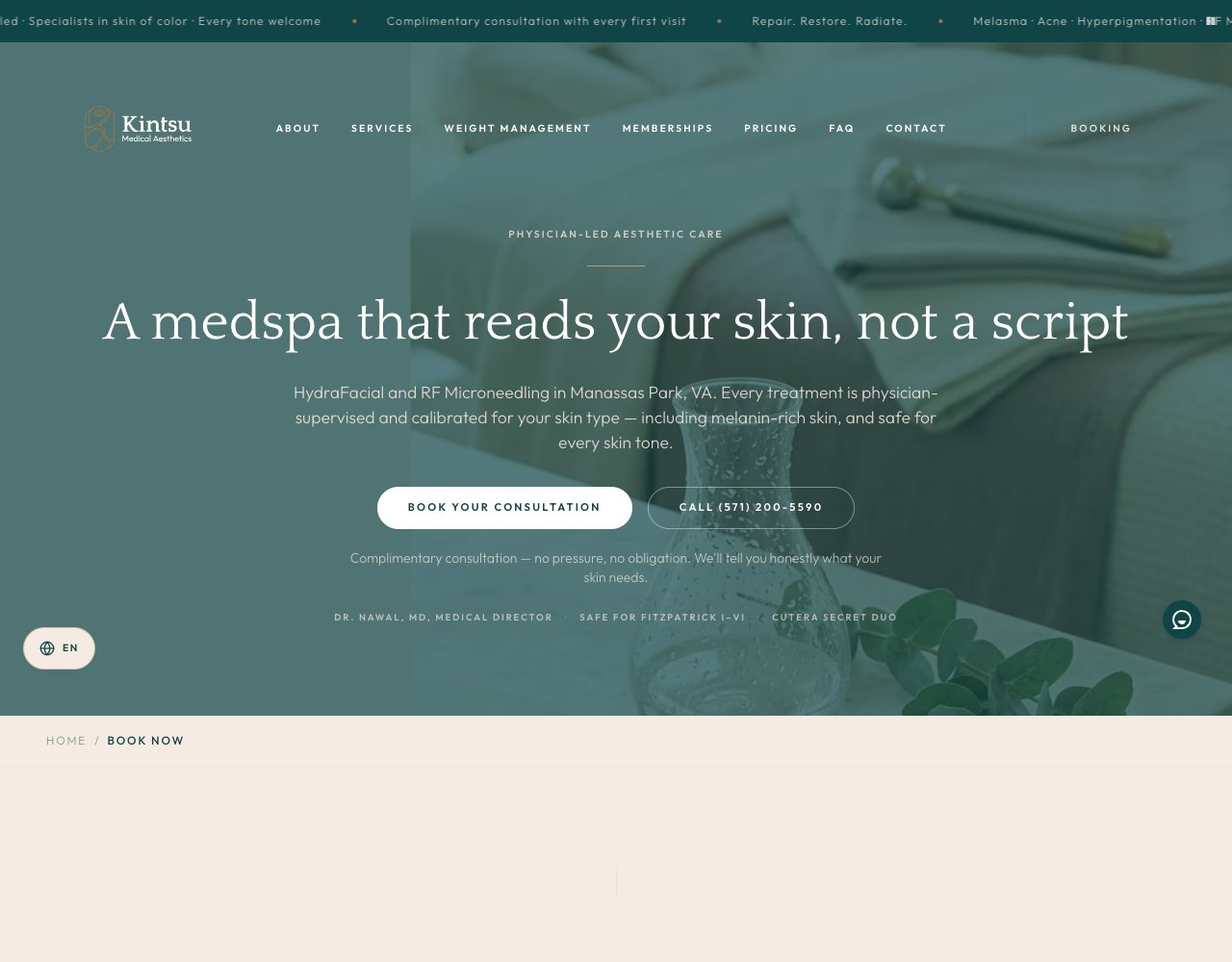
The owner had three options. Drop in the vendor's stock widget on an off-brand page. Keep taking bookings by phone and retyping them. Or pay for a booking path built into Kintsu's own site.
She chose the custom path because Kintsu needed its own look, no ad or analytics trackers, and one place appointments live. Changes that could alter a price or a staff record still wait for a person to approve them.
One requested feature died the same way, before anyone wrote a line of code. We asked whether a Groupon voucher could be redeemed straight into Zenoti, found out it couldn't, and wrote the answer down.
July 17, 2026
Stopped on purpose, before anyone wrote a line of code
Redeem a Groupon voucher straight into the booking software
- What we asked
- Whether Groupon would let Kintsu redeem a voucher into Zenoti automatically, instead of the front desk doing it by hand.
- What we found
- That access is issued to the big point-of-sale vendors, not to individual practices. There was no version of this that Kintsu could have.
- What happens instead
- Staff keep redeeming in the Groupon merchant app, exactly as before. The answer is written down, so nobody has to ask it twice.
An hour of asking is cheaper than a month of building the wrong thing, and we did not bill for the hour.
What the connection does
The connection runs one way. A booking made on Kintsu's page goes into Zenoti and nowhere else.
Six pieces, one place the records live
Everything talks to your booking software, and nothing changes it without you
Four of the six are working today. Two are on the way, and both of those are named.
Online booking page
LivePatients book themselves in, straight into your booking software.
Live since July 12, 2026. Nothing is stored, and no patient details show up in web addresses.
Lead inbox
LiveEvery enquiry from your website lands in your booking software as a guest.
Duplicates are skipped, and your front desk is told straight away.
A private assistant that reads your bookings
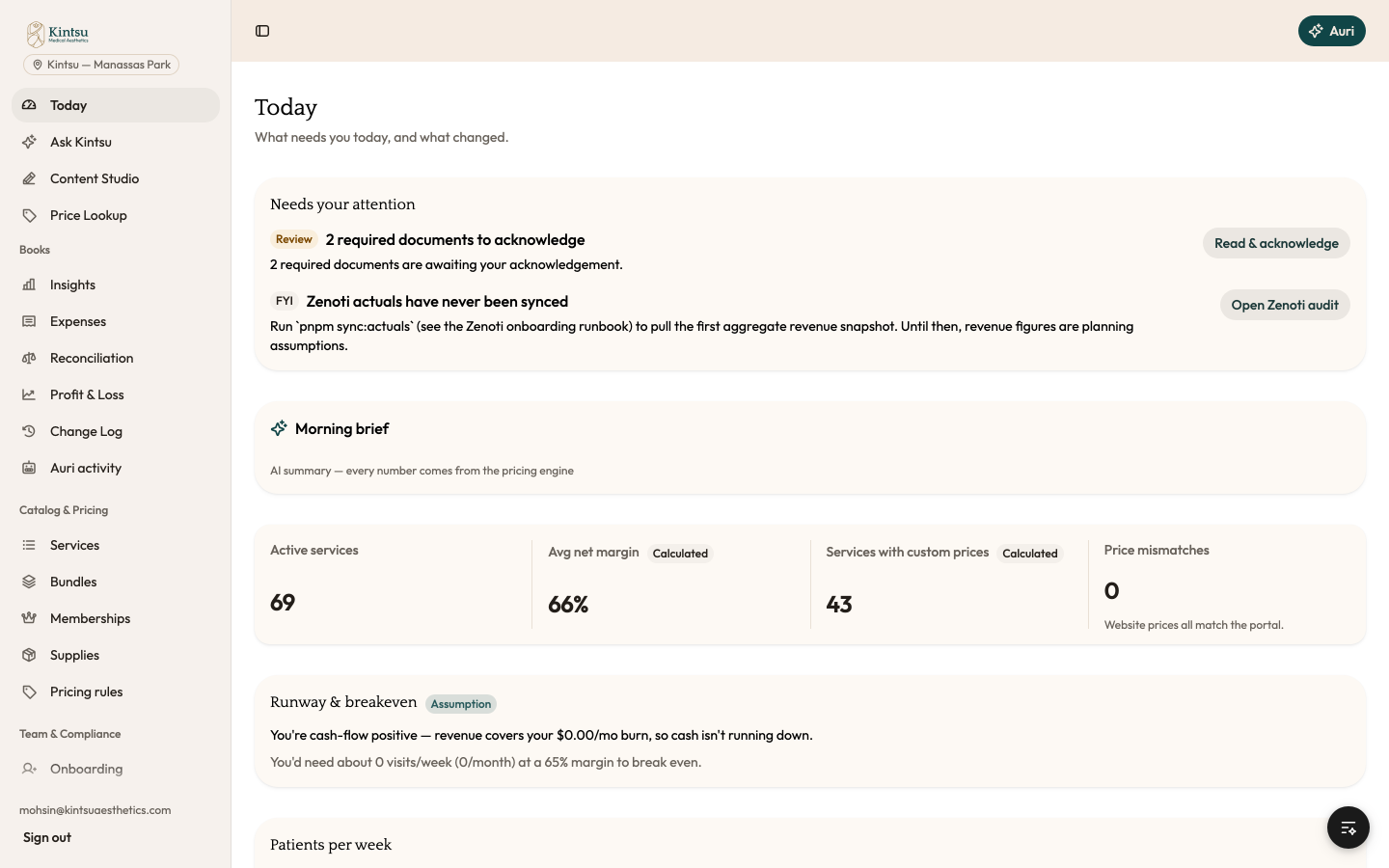
LiveIt answers questions about your own data and can only read, never write.
It runs on one machine and is never open to the internet.
Read-only staff dashboard
LiveYour team sees what it needs and cannot change anything.
It never touches anything that carries patient details.
Change tools that ask you first
ComingThey show you exactly what would change, and apply nothing until you say yes.
Built and ready. Nothing has been applied for real yet.
Appointment numbers on the dashboard
ComingThe card is built and sitting there, waiting on your booking software vendor to open up appointment data.
It stays visible and tells you plainly that the data is not there yet.
Your booking software
The one place your records live
One thing is not in this picture. We built a version of the assistant that could be reached over the internet, then set it aside the same day and kept everything on one machine.
One system of record, no double entry, and no change you did not see coming.
- Patients pick a service, a provider, and a time without leaving Kintsu's website.
- The appointment lands in Zenoti as it's made.
- The website keeps no patient or appointment records of its own.
- Outside reporting tools can read approved booking data and can't see patient information.
- A price or staff change shows a preview first, then waits for a person to approve it.
Before any of that was built, we tested what Zenoti actually lets an outside system read and write. Zenoti confirmed in writing that staff records can be changed from outside, along with a product's price, quantity, and active flag at a given center. New services, products, memberships, packages, and rooms can't be created from outside. That answer set the scope, not our wish list.
The privacy review
Three reviewers checked the design, the working prototype, and the hosting plan separately on July 3, 2026. They found 24 problems, including a calendar invite that carried the service and provider names. All 24 were dealt with before launch.
Hosting moved twice before it landed on Kintsu's own server. Booking then launched quietly, hidden from search, out of the menu, and with no ad or analytics trackers, so the team could test the whole path before promoting it.
July 3, 2026
Twenty-four privacy problems, dealt with before a patient saw the page
Three reviewers read the booking design, the prototype and the hosting plan at the same time, each without the others.
24 problems found, none of them by a patient. Three of them are below.
A calendar invitation carrying the treatment and the provider
Read by a reviewer who had the booking design and nothing else.
Anyone who saw that invitation would have learned what a patient was booked for and with whom. Both names came out of the link before booking opened.
An analytics call reporting the whole web address a visitor left on
Read by the reviewer holding the prototype.
It now reports the site name and the page, and nothing after them, so nothing a visitor typed or picked travels out with it.
A guest lookup that could carry patient details in the request
Read by the reviewer holding the plan for moving the data.
This one was a risk rather than a live leak, so it was recorded in writing and designed around rather than left unsaid.
The embarrassing privacy problem gets found by your own people, before it is found by a patient.
What went wrong
An outside review found three serious bugs, two of which could report success after a write had actually failed. The reviewer caught them before launch. A false success means the front desk believes a change landed when it didn't. Both paths now fail loudly instead.
One dashboard card is still blocked. Kintsu's key is refused on the permission it needs, and the request has been open with Zenoti since July 26, 2026. We left the card on screen showing the honest error rather than hiding it.
A visitor reported a failed booking on August 15, 2026. Digging in, the real outlier turned out to be August 18: 213 visits and zero booking actions, against roughly ten expected. The request log from that window had already been erased by an unrelated update, so we asked Zenoti for its records instead of making a claim we couldn't prove.
What we can prove today
- Delivery fact. Online booking has been live on Kintsu's website since July 12, 2026.
- Delivery fact. 24 privacy problems were found and dealt with before launch.
- Delivery fact. The connection was checked against Kintsu's real catalog of 67 services.
- Observed. Zenoti stays the one place appointments live, and the website stores none of its own.
The first scorecard, due December 2026, measures the Zenoti booking count since July 12, 2026.
Is this a fit?
This fits a business whose marketing site and scheduling software don't speak to each other, especially when retyping appointments creates delays or mistakes. It works best when your vendor will put its permissions in writing.
It isn't a fit if the vendor's standard widget already meets your brand, privacy, and reporting needs.