The gap in the off-the-shelf tools
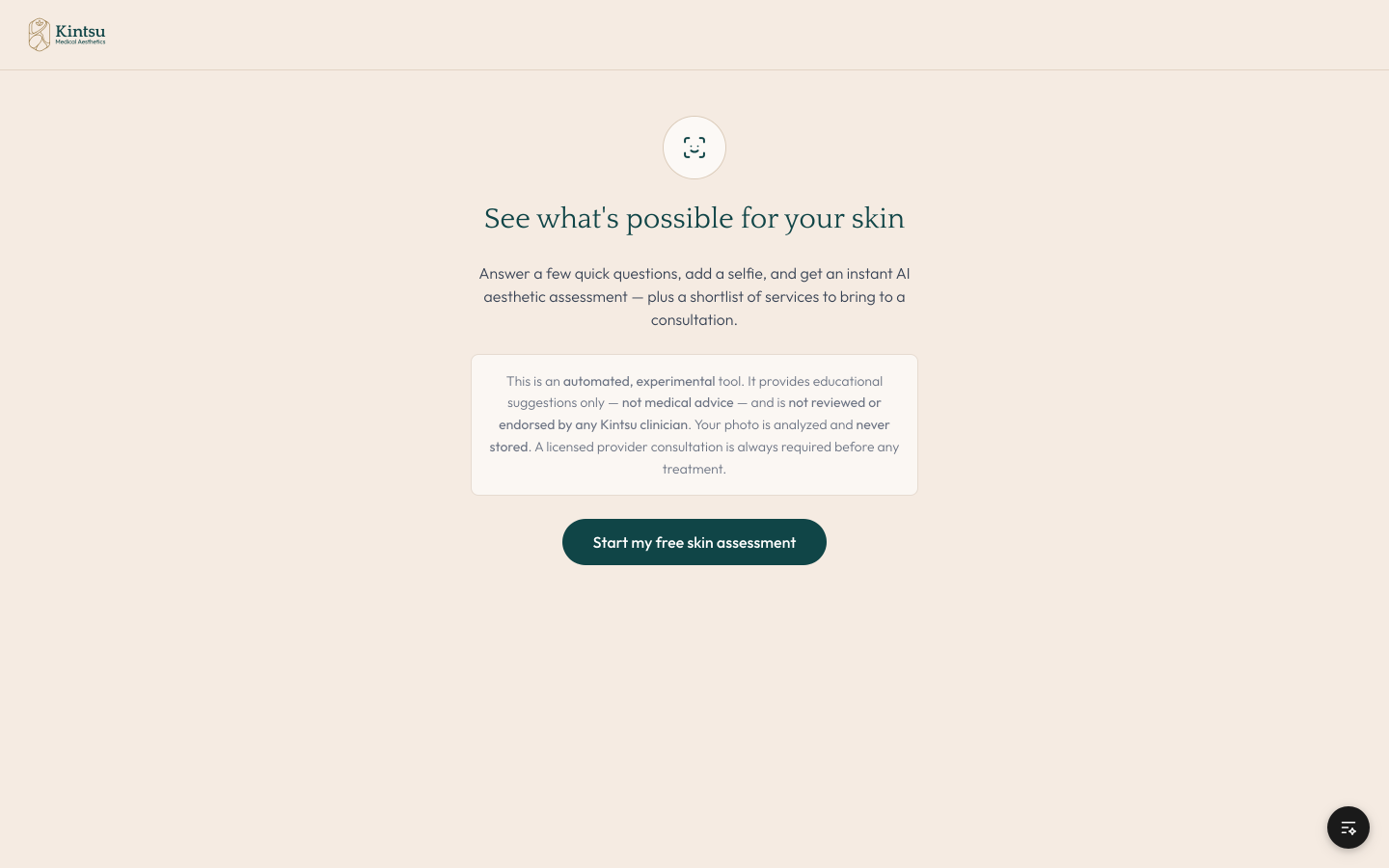
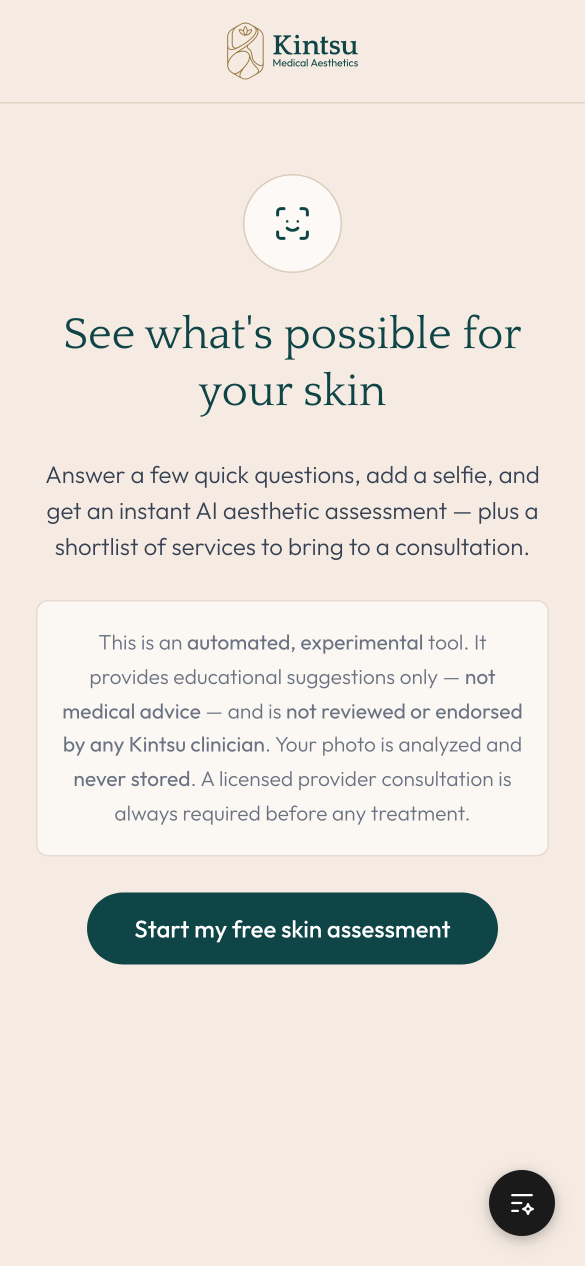
Kintsu's visitors want some idea of what a treatment would do for their skin before they pick up the phone. A generic skin widget answers that badly for this practice, because most of them are tuned on lighter skin and misread deeper tones.
Two more constraints came with the request. Nothing the tool says can read as a medical diagnosis. And it can't create a second pile of sensitive face photos sitting on somebody's server.
Generic widget or custom tool
The owner had three options: drop in a generic skin widget, do nothing and keep answering questions by phone, or pay to build something narrow and custom.
She chose the custom tool, on three conditions: no diagnosis language, no photo kept anywhere, and no health information travelling with an enquiry. Anything that failed a test stayed out of the build.
The first decision was never which AI model to use. It was whether a custom tool could help a visitor at all without making a medical claim.
What the tool does
Five frames, about six to eight seconds
A skin consultation taken on a phone, in the time it takes to hold still
The phone screen is the lamp. It changes five times while the camera watches, and the visitor does nothing but sit there.
One. DarkThe room as it is
Think of the lighting booth a dermatologist works in, shrunk down to the screen a patient is already holding.
We tried colored light first and dropped it, because it reads less accurately on darker skin, which is exactly where this tool has to be strongest.
A visitor learns which treatments fit them before they call you, and no photograph is ever kept.
- Walks a visitor through five quick phone-camera frames.
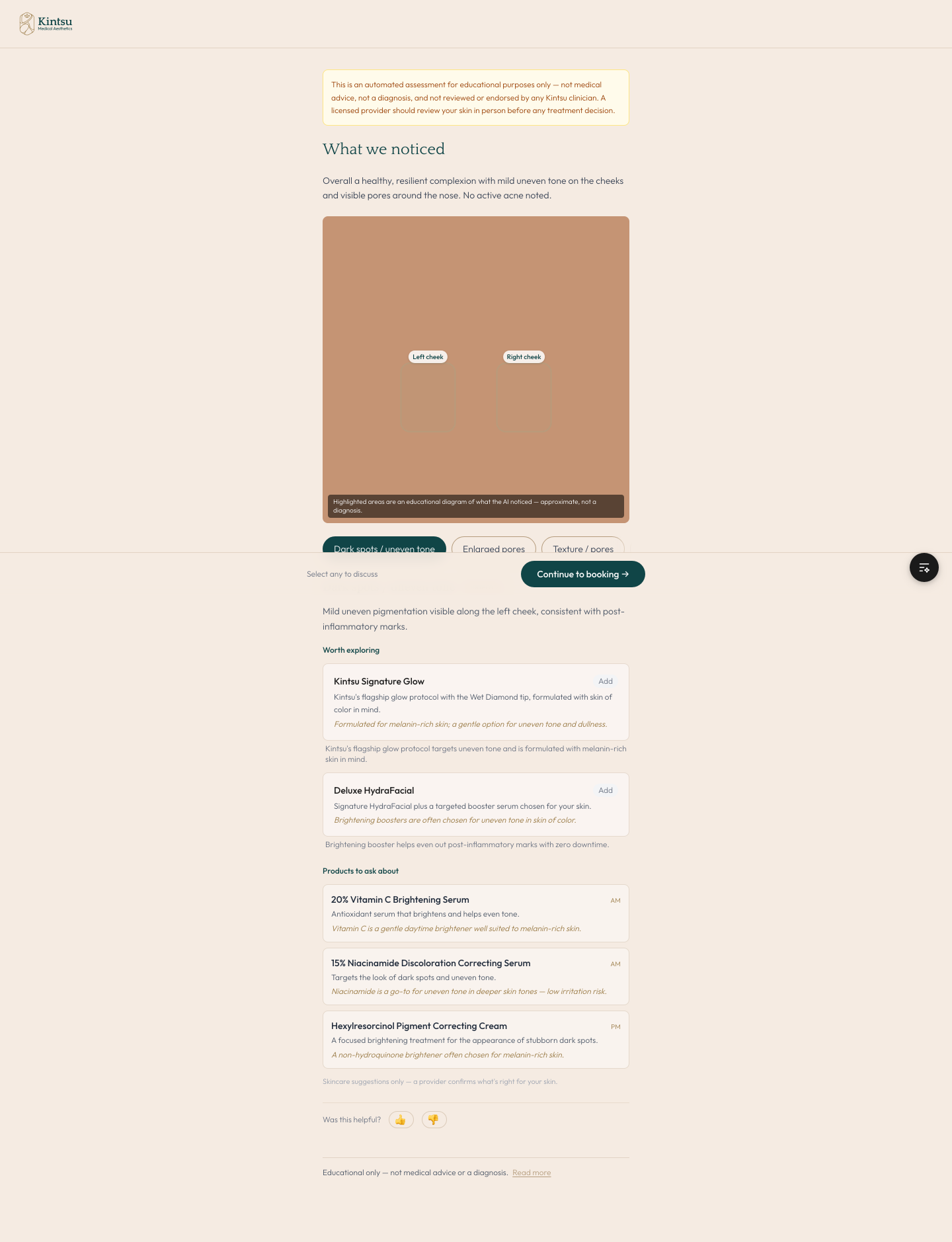
- Describes ten plain concerns across eleven areas of the face.
- Suggests only treatments Kintsu actually offers.
- Passes an enquiry toward Zenoti, the scheduling software the front desk already used, with no health information attached.
- Keeps no account, database, image, or result.
The job is deliberately narrow. The tool helps a curious visitor decide whether to get in touch. It doesn't replace a clinician, and it never pretends to.
Safety was built in, not bolted on
The model isn't allowed to use condition names, causes, or clinical grading. The design leaves out redness and other signals that are unreliable on deeper skin tones. Results are drawn on the visitor's own photo rather than a regenerated one, because a regenerated image can quietly change someone's skin tone. No photo is stored at any point, so there's no second pile of faces to lose.
The owner cleared the tool for non-diagnosis use on September 4, 2026. Attorney review, a Virginia privacy check, a spend cap, and medical-director sign-off still stand between it and the public.
One photo, start to finish
A skin tool with nowhere to keep a patient's photo
Three points where a photo could have been kept, and what happens at each one instead.
Step one
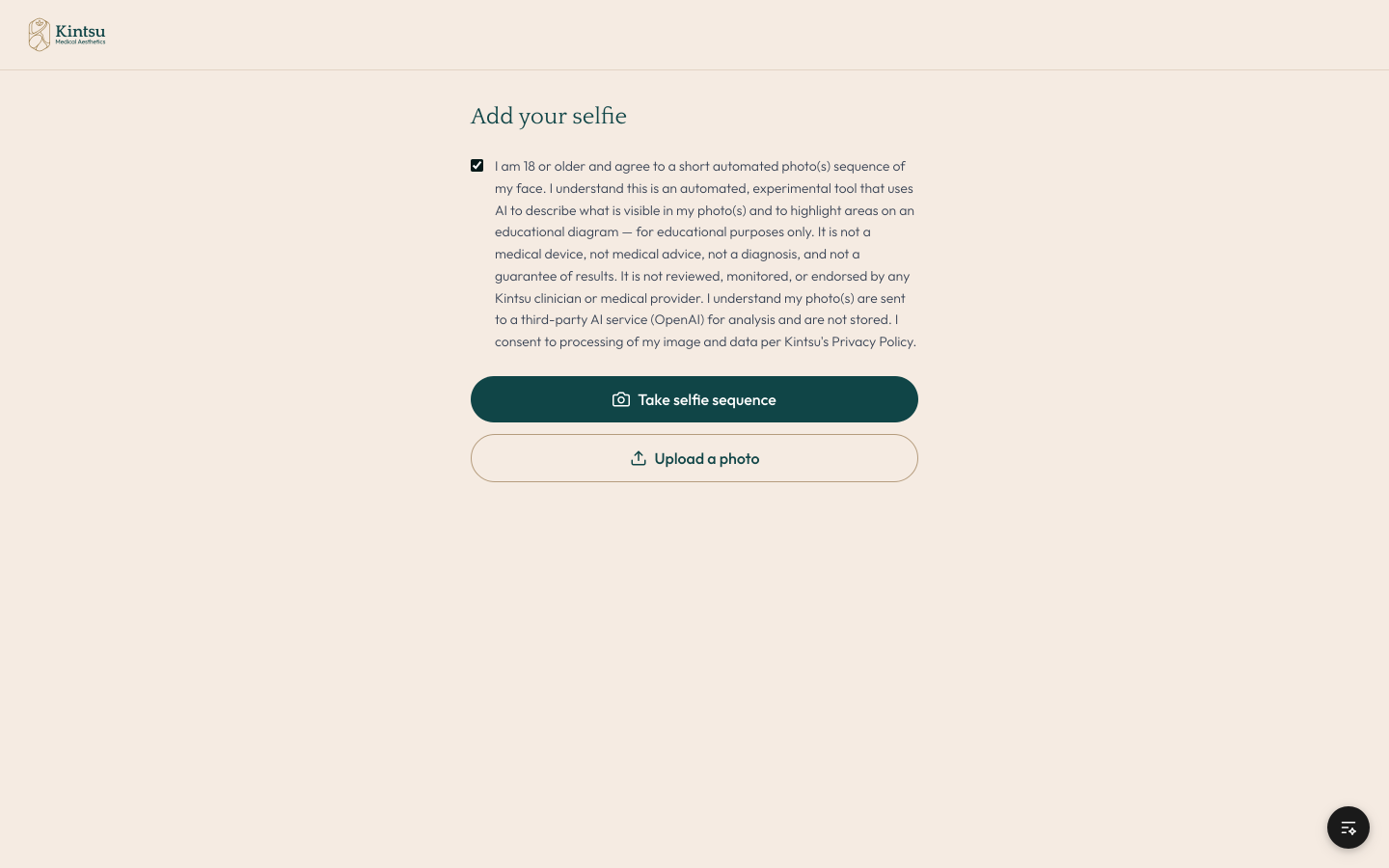
The visitor agrees, then takes the photo
It is taken on their own phone, and it stays on their own phone.
Step two
The photo is read once, and then it is gone
No database, no account, no stored photo and no stored result. There is nothing kept, so there is nothing to lose.
Step three
Only the treatments travel to booking
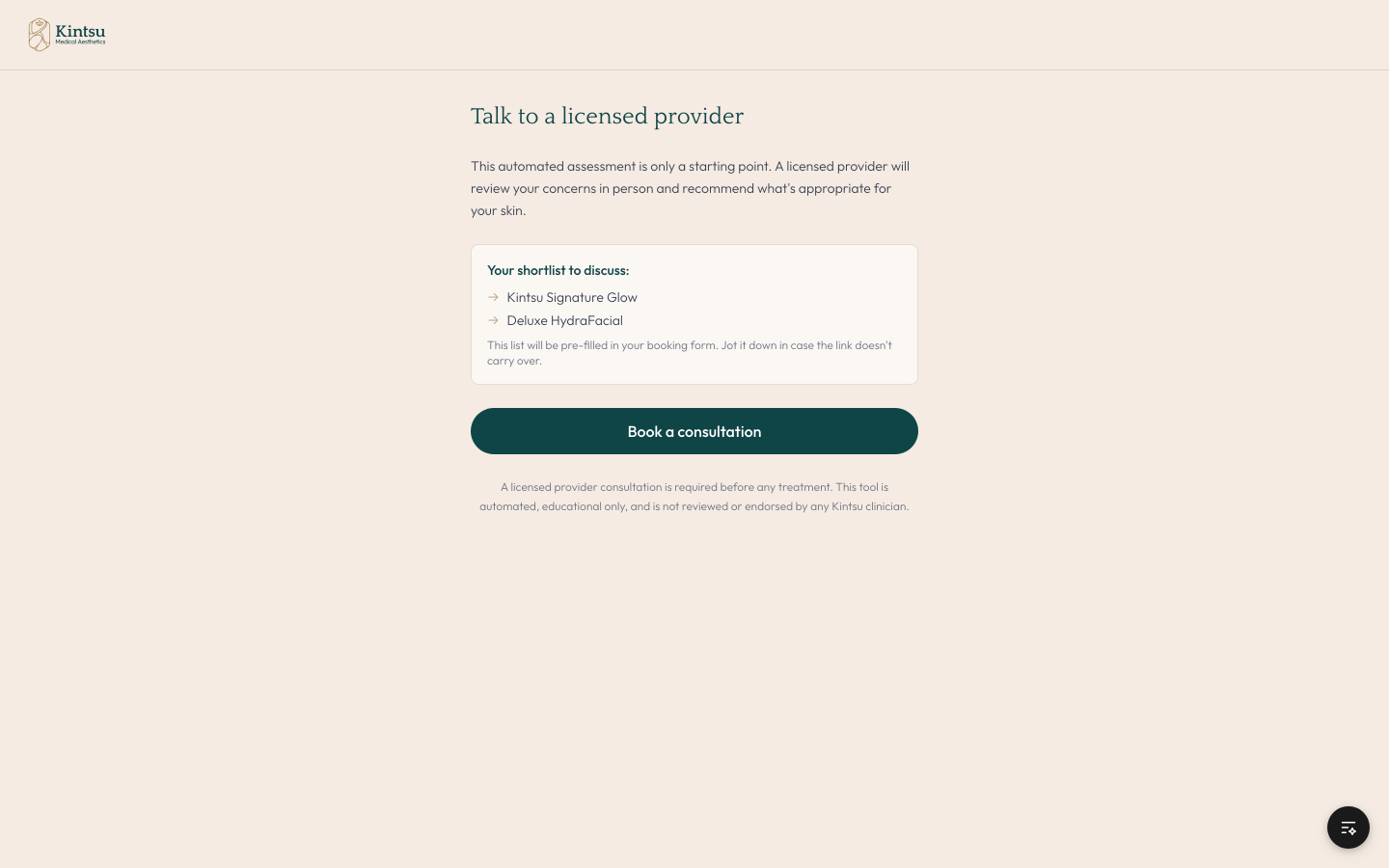
What reaches your booking page is the list of treatments that interested them, with no health detail attached.
A tool built to draw patients in cannot become the thing that leaks their faces.
Three failures that kept it private
For about six weeks the live tool quietly served an older single-photo capture instead of the five-frame version. An audit caught it on August 20, 2026. Visitors were getting a weaker read than the one we'd designed and tested. The five-frame capture is now the built-in default, with a switch that has to be thrown on purpose to change it.
A missing security key broke every consultation for a day in August 2026. We found it and fixed it the same day. Anyone who tried the tool that day got an error instead of a result. The deploy script now fails closed rather than shipping without the key.
The tool measured head tilt backwards, because the math that reads the camera's angle had two values swapped. An outside reviewer caught that, not us. A backwards tilt check waves through a poorly framed photo and rejects a good one. The math was fixed.
Those three are a large part of why the tool is still private.
What we can prove today
- Delivery fact. A working, tested version existed about 48 hours after the plan was written.
- Delivery fact. The five-frame capture became the built-in default on August 20, 2026.
- Delivery fact. No photos, accounts, or results are stored, by design.
- Observed. The tool is still private, pending attorney and medical-director sign-off.
The first scorecard, due December 2026, measures how many visitors finish a consultation and how many of those get in touch, once the tool is open to patients.
Is this a fit?
This fits a regulated or specialized business whose existing software handles a valuable customer interaction badly. It works best when a slower, reviewed launch is acceptable.
It isn't a fit if you need a quick widget, a diagnosis tool, or a public launch before the safety review is finished.