Where MKA USA started
The raw material existed, scattered across a shared drive of roughly 71,000 files: a guidelines PDF from 2016, a 42-page proposal from 2013, per-brand guideline PDFs, and every logo file with its real colour values buried inside.
What did not exist was a system. When a chapter secretary in Cleveland needed a logo with "Cleveland" on it for a flyer tomorrow, the fastest path was Canva and a guess. A system only wins if the correct logo is also the quickest to get.
The archive had gaps, and in places it was wrong. No file stated a mission, a vision, or values for any of the nine brands. Two brands' artwork existed only as flat images, and one brand had no colour logo at all. A file named dark-grey_logo.eps was not dark grey. It fills a navy-black, and an earlier pass had shipped it as that brand's logo while the correct crimson masters sat unused in the same folder. The client caught it in one line: "I don't remember any of them being navy."
The realistic alternative was a branding agency engagement, nine times over, or what most volunteer organisations do: keep the shared drive and let every chapter reinvent the brand each week.
July 21 to September 5, 2026
46 days, including the calls we took back
The milestones that matter, including the decisions we reversed once we checked.
- Project starts. 9 brands scaffolded, 1 built, 8 placeholder
- 71,000-file archive audit scores the first build 4.6 out of 10Triggers a full rebuild onto one shared page layout, the same day.
- 3 of 4 first-interview decisions reversed on the evidenceFQC palette, MASQ mark and AMSA palette reversed; MIST direction retired.
- Sign-in, private brands gated, downloads logged
- Site live, with a valid certificate
- Chapter logo builder shipped after 6 rounds of client feedback
- Duotone icon ban reversed after checkingRendered output is one fill color plus a path at 20% opacity. One color, not two inks.
- AI-assistant server live
July 21 to September 5, 2026. 46 days, 223 changes shipped. Live on the client’s own server since August 2, 2026.
- Live
- Reversed
A filled dot shipped. A return arrow is a decision we took back after checking it.
Diagram · from MKA USA project records · September 2026
What changed
MKA USA Brand Center
Nine brands, four tiers, one set of rules
The MKA USA Brand Center hierarchy as of September 5, 2026.
Every tier below inherits: the colour and font list, the shared page layout, the standards.
MKA USA
Parent. Owns the colour and font list and the standards.
Auxiliary
Atfal
MASQ
AMSA
Own accent and voice nuance. Must visibly relate to the parent.
Event
National Ijtema
Majlis-e-Shura
Sign-in
MIST
Fazl-e-Umar Qaideen Conference
Sign-in
The most expressive tier. Still inherits the parent's structure.
Property
Baagh-e-Ahmad
Sign-in
A tier added for one property that is neither an auxiliary nor an event.
- Shared colour and font list: 9 required names
- Shared page layout
- Standards and voice frame
Brands override values. Brands never rename the list entries.
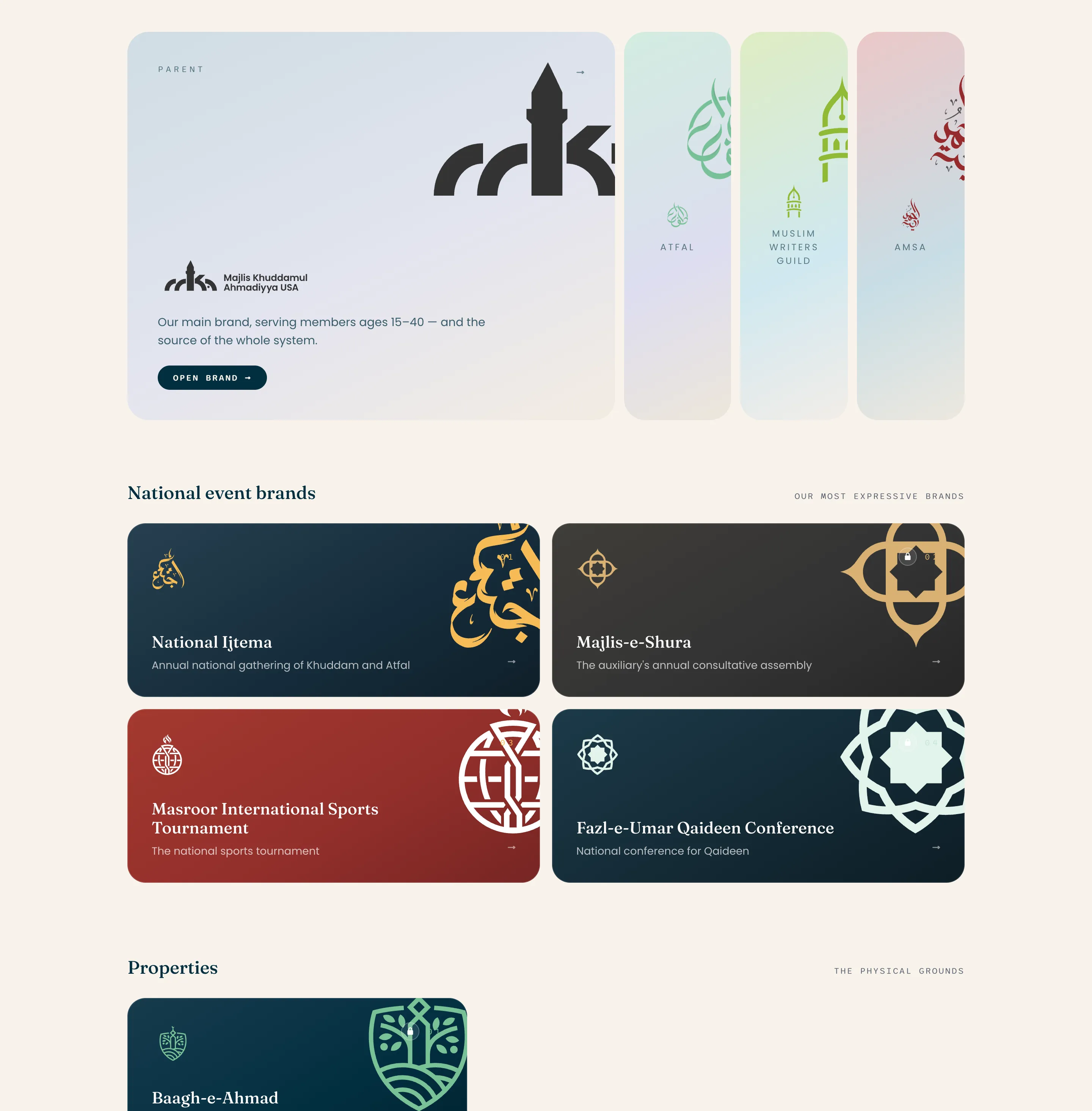
Majlis-e-Shura, the Fazl-e-Umar Qaideen Conference and Baagh-e-Ahmad carry a sign-in tag: the symbol is public, the guideline is behind sign-in.
Every tier inherits the parent's structure. What changes is the accent and the voice, never the list names.
Diagram · from MKA USA project records · September 2026
Nine brands now sit in one place, in four tiers: the parent body, three auxiliary bodies, four event brands, and one property. The parent owns the standards. Auxiliary bodies keep their own accent colour and voice but must visibly relate to it. Event brands are the loudest tier and still inherit the parent's structure.
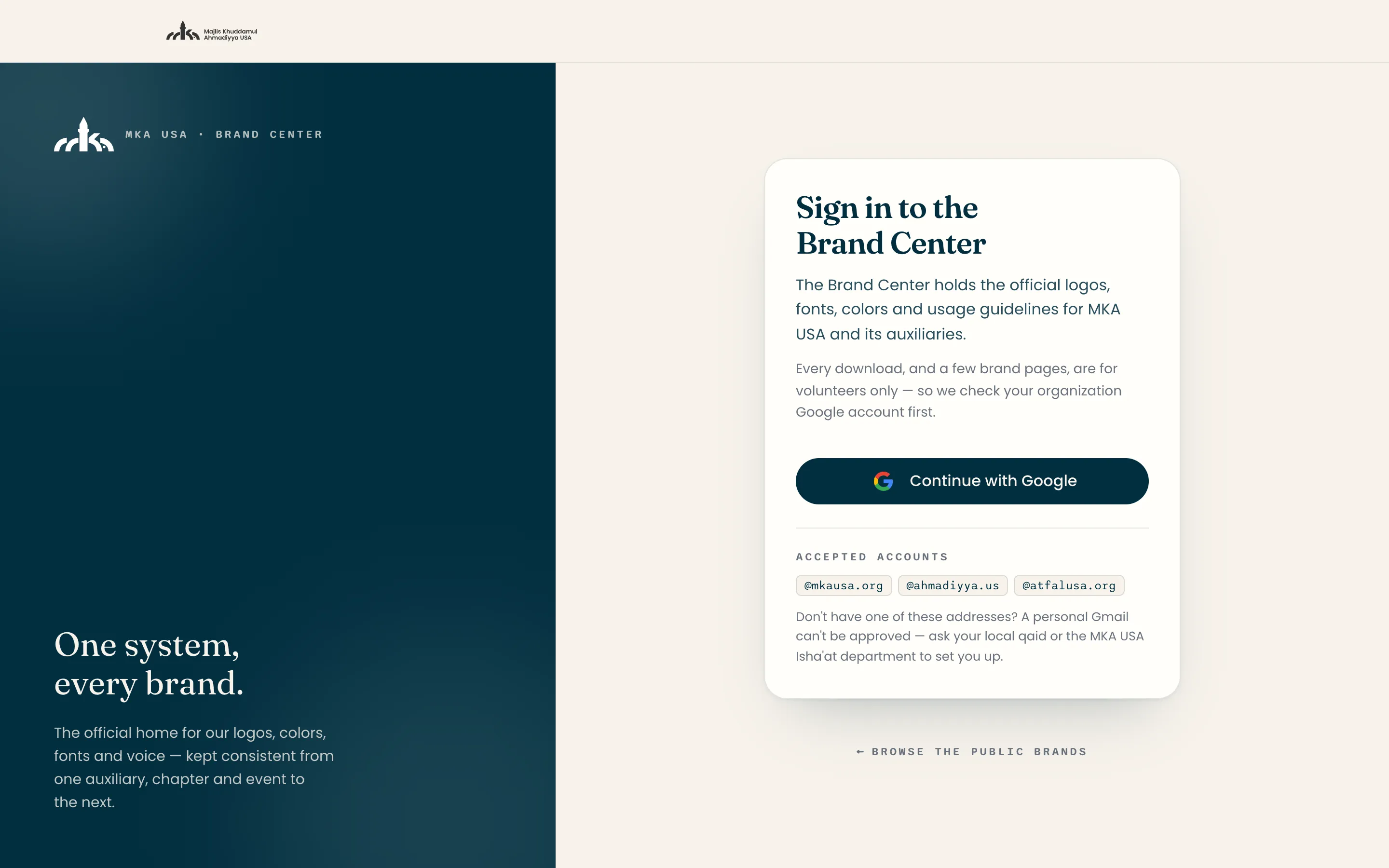
A sign-in wall that hides guidelines, not brands. Members sign in with a Google account, and only three approved organisation email domains get through. A private brand still shows its symbol on the home page. The brand's existence is not the secret. Only its guideline is.
Downloads that leave a record. Every file goes through one download route, and each download records who took what, when, and from where.
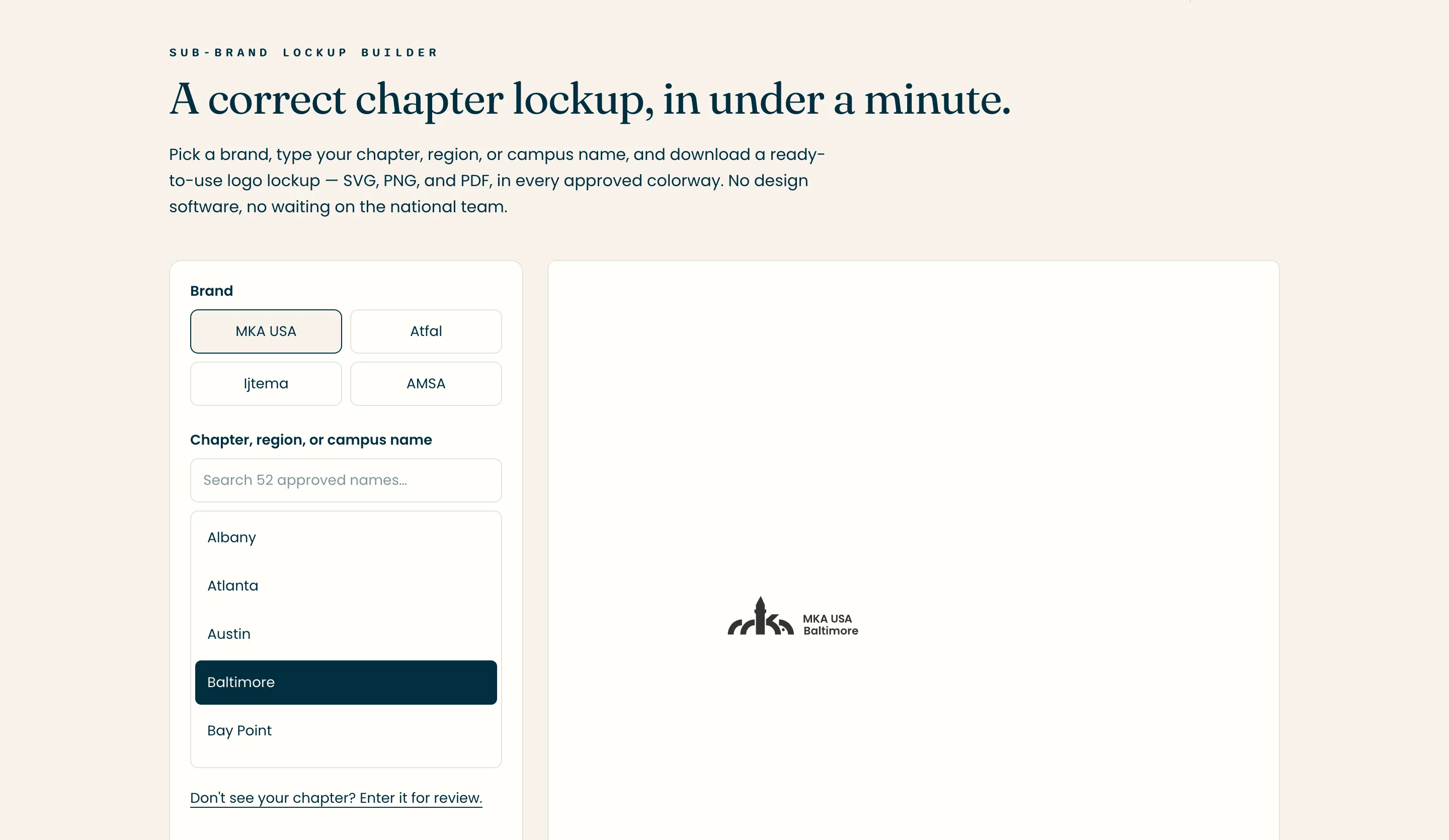
A chapter logo generator. Four of the nine brands sub-brand to a region, chapter, or campus. A volunteer picks from a roster of 182 ratified names and gets a package back: vector and image files at three sizes, a print-ready PDF, and a one-page usage sheet with clear space, minimum size, do and don't, and the palette values.
Screenshot · mkausa.design · September 2026 · members-only page
An AI assistant that answers from the real rules. The site runs a server with 18 tools an assistant can call, covering brands, guidelines, logos, fonts, colours, icons, and two checks. Before it existed, using AI on a flyer meant pasting colour codes into a chat window and hoping the assistant did not invent a rule.
How it works
The whole system rests on one idea. Every brand keeps its own colour and font list, the one everything on the site reads from, plus its own written content. Nine entries are required of every brand, and a brand may change a value but never rename one.
That is what made the rebuild possible. All nine brands share one page layout, and only two slots on it change per brand: the opening hero and one signature section. Everything else is the shared layout, coloured by whichever brand you are looking at. One place to fix a mistake instead of eight.
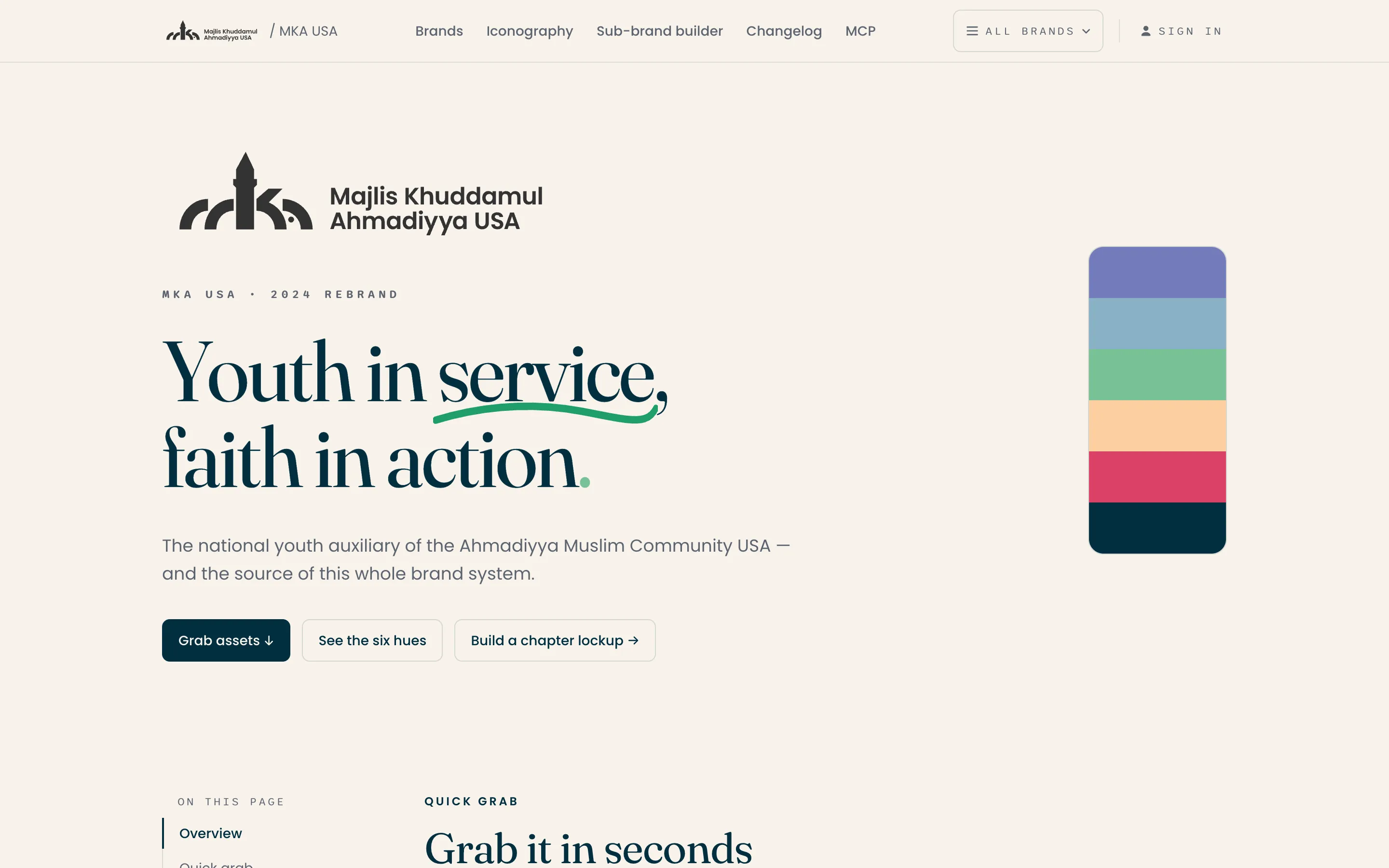
Screenshot · mkausa.design · September 2026 · public page
Sign-in is enforced by the server, not by the screen you see. The check runs before anything is saved, which is why a personal Gmail is refused by design. Nothing is downloadable unless it is on an approved list, so a missing item fails visibly instead of quietly leaking a private brand.
Downloads all funnel through a single route, so the gate, the log, and the safety check live in one place. One limit is worth naming: 32 files are both shown on public pages and separately downloadable, so those are already public whatever the gate does. The gate earns its keep on files that are never displayed.
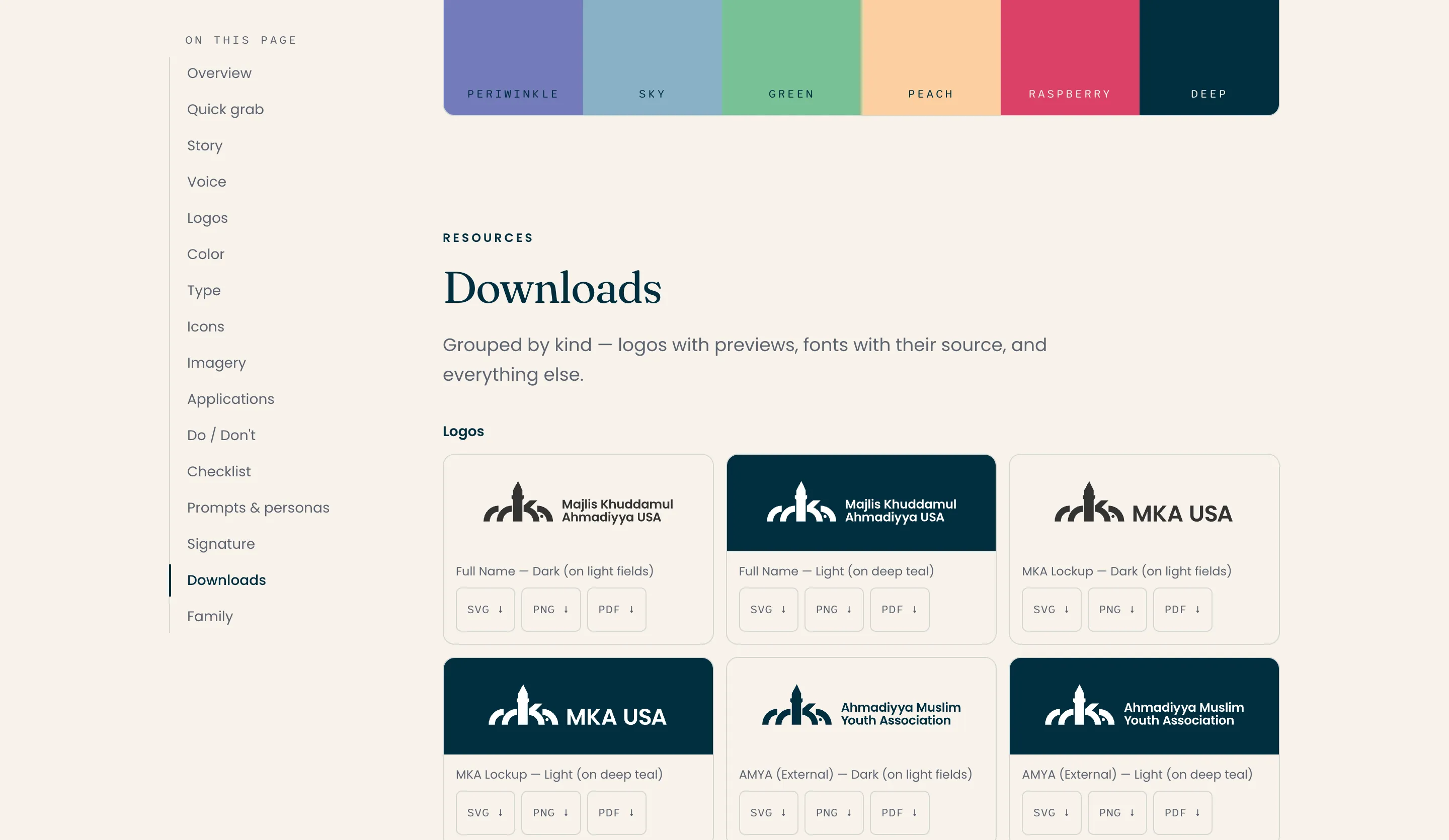
Screenshot · mkausa.design · September 2026 · members-only page
The AI server reuses that same wall instead of building a second one. A member creates a private access key, pastes it into their assistant, and the server keeps only a scrambled copy. The key carries no permissions of its own. It gives the assistant exactly what that person could already see, which is why private brands needed no extra rules on the AI side. It has a cost: assistants that connect through a web browser cannot use this server at all.
As of September 5, 2026
The assistant gets in the same way a person does
One boundary checks both: a person's sign-in and an assistant's access key.
Sign-in boundary
Both paths converge here, checked the same way as the website: Google sign-in, three approved organisation email domains, checked on every request before anything runs.
A bad credential gets a typed reason and a link to renew it; a failed check gets a different, retryable status, so a caller can tell the two apart.
Guidelines
Colour and font list
Gated downloads
Through the same single audited route a person uses, with the same log row written.
Behind the door: 18 things an assistant can ask for, from the brand list to the logo files.
By choice
Web-based AI connectors cannot use this server. The fuller sign-in standard they need was deliberately not built for a client nobody had asked for. Recorded as deferred, not closed.
The access key is not a second permission system. It is the member's own access, handed to their assistant.
Diagram · from MKA USA project records · September 2026
The site keeps itself honest in two ways. It writes its own update log from the notes attached to each change, and refuses any change that promised an entry without writing one. Four browser checks also run against a real copy of the live site: one walks every image while signed out, one follows every download link and proves an anonymous visitor still gets bounced to sign-in, one exercises sign-in, and one drives the AI server end to end. They catch what ordinary tests cannot, like a private brand that fell open.
We measured the colours instead of arguing about them, and one failing pair is published on purpose, so people see the limit instead of guessing at it.
What went wrong
Two-tone icons were banned across four brands on a premise that turned out to be wrong, and the client was the one who pushed back. Rather than argue, we rendered the output and looked at it, then replaced the ban with a rule that depends on how the icon is printed. The reversals table below has the rest.
Reversed between July 22 and August 10, 2026
Five rulings we took back after checking the evidence
Does this team defend its first answer, or change it when the evidence says otherwise?
Three of four decisions from the first leadership interview were reversed or clarified once the client’s own archive was audited, on July 24, 2026.
First recorded decisionAMSA inherits the parent palette, crimson as a legacy accent.
What the evidence showedThe archive shows AMSA runs its own crimson-led system.
OutcomeReversedInheritance withdrawn.
First recorded decisionA mint-and-gold hybrid palette for the Qaideen Conference.
What the evidence showedGold is absent from produced collateral. The deep navy ground is not removable.
OutcomeReversedMint on navy is canonical, gold demoted.
First recorded decisionThe MASQ mark is Arabic calligraphy.
What the evidence showedIt is a minaret concealing a fountain pen. Pictorial, not calligraphic.
OutcomeReversedA planned commission cancelled.
First recorded decisionMIST ships a loud sports treatment.
What the evidence showedMIST is an intellectual competitive event with institutional prestige, not a sports brand.
OutcomeReversedA finished direction retired for a ceremonial crest.
First recorded decisionDuotone icons banned across four brands: they add a second ink.
What the evidence showedRendered output is one fill color plus a path at 20% opacity. One color, not two inks.
OutcomeReversedBlanket ban replaced by a medium-conditional rule.
A sixth audit finding went the other way. Two Qur’an citations were flagged as errors, both were correct, and nothing was changed.
Each row names the thing that changed the answer. The best result in the set is the one where the audit was wrong and nothing moved.
Diagram · from MKA USA project records · September 2026
The icon work was deployed the whole time and nobody could reach it. The client reported the icon guidelines missing, which reads like a failed deploy. It was not. The content sat behind sign-in, the navigation never used the word "icon," and the document had never been copied into the shipping files. The fix added a public icons section and a public page showing the document directly.
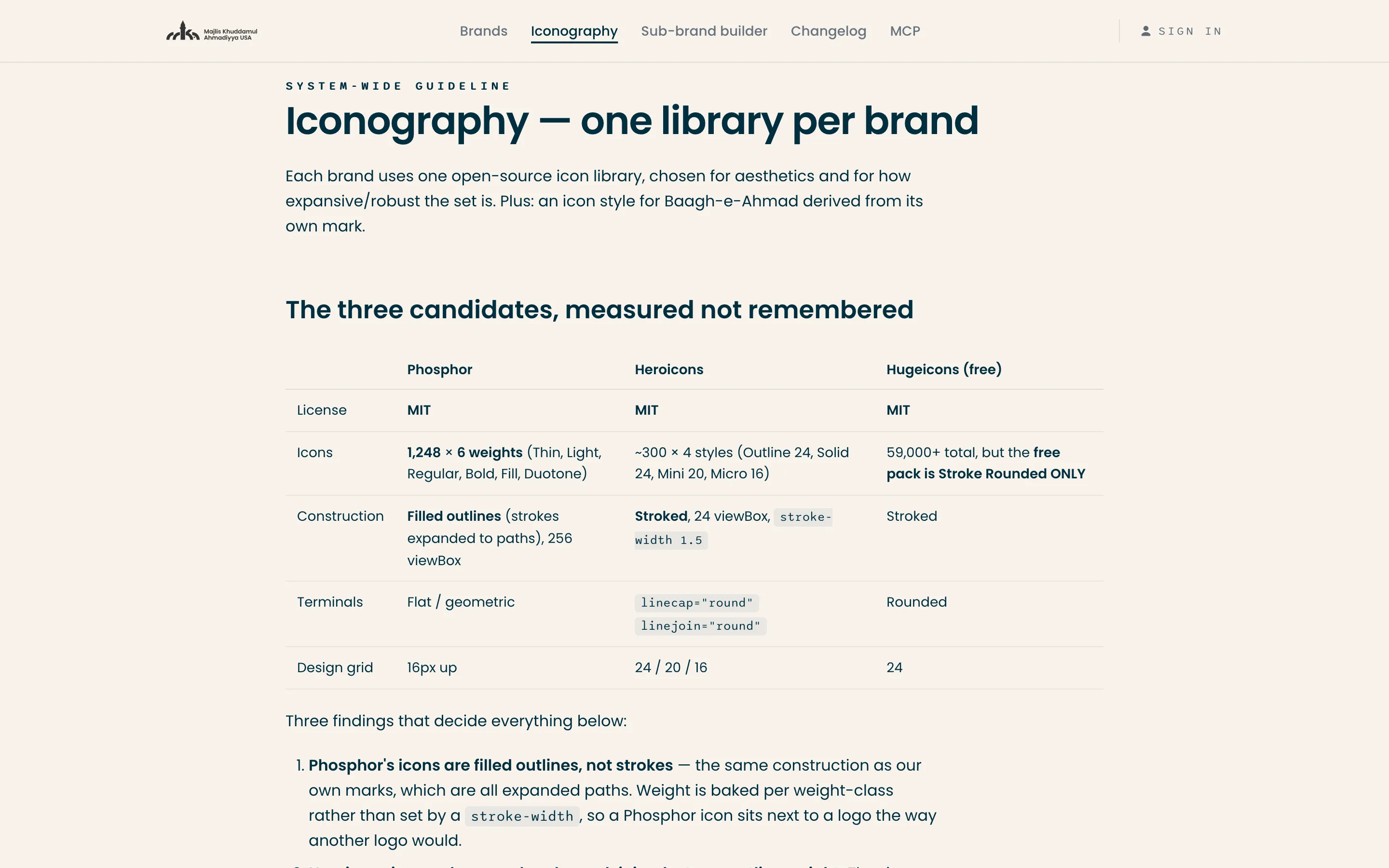
Screenshot · mkausa.design · September 2026 · public page
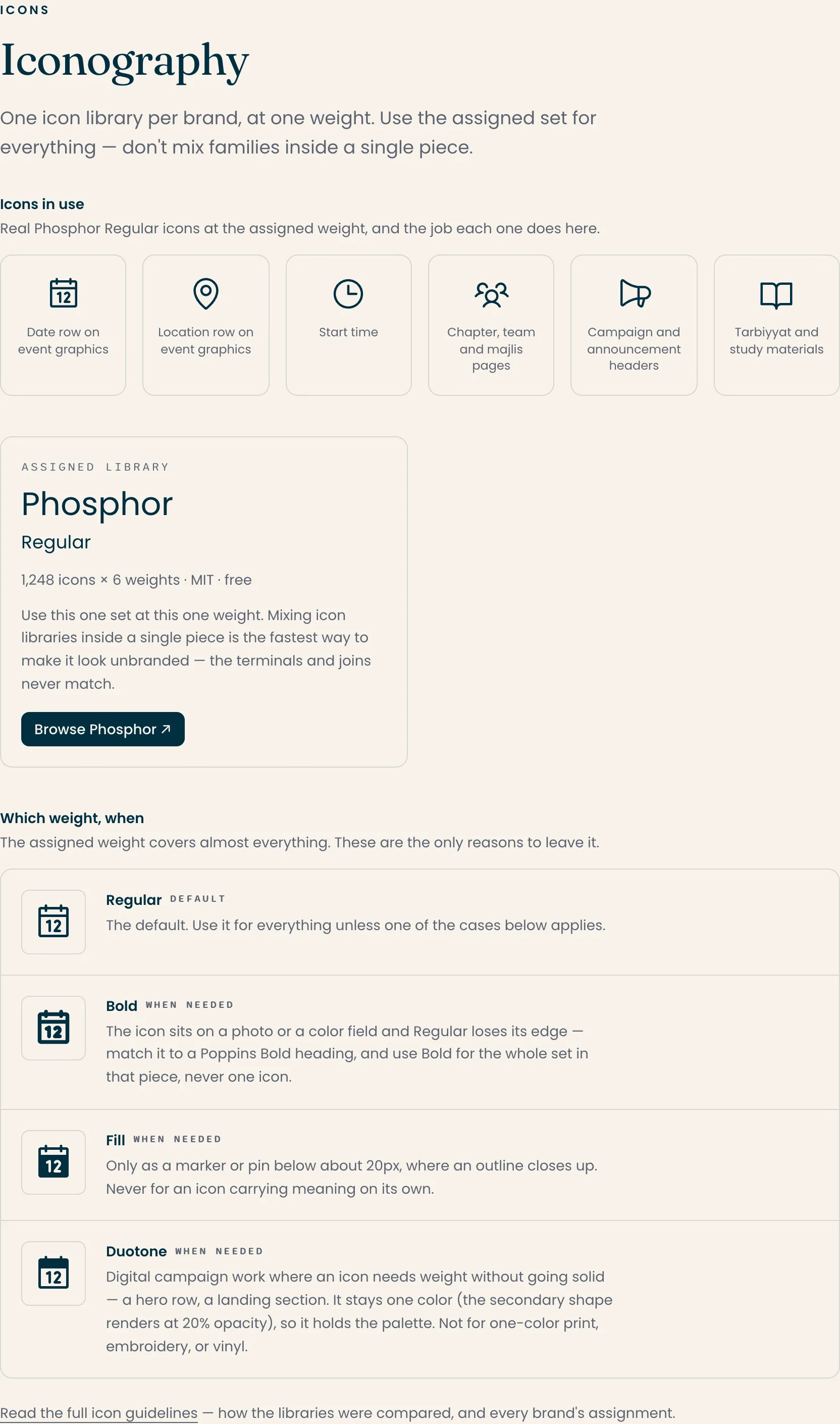
Screenshot · mkausa.design · September 2026 · public page
A logo animation the client hated was pulled out in full: "reset this logo animation, get rid of it you ruined it." A separate size fix, correcting a squashed symbol, was kept on purpose. Undoing the thing someone hated does not mean undoing the thing that was right.
A copy audit's biggest catch was a fix that must never be applied. Two Qur'an citations came back flagged as off by one, and both were correct, because the Community's editions count Bismillah as the first verse. Nothing changed, and the convention went into the voice guide so no future editor undoes it.
Eighty-four stray branches of work were investigated and then left alone. The client asked for them to be resolved, which sounds like a merge. We compared them against the shipped code first and found a net loss of 1,538 lines and zero unique work. We wrote down why before doing anything: destroying real work to recover nothing is not a defensible reading of "get the latest information."
Live credentials nearly reached the error tracker. A setting the vendor recommends, used exactly as documented, put live access keys and session cookies into error reports. A reviewer with no prior context proved it before it shipped, and a scrubbing step went in. Then the tracker received nothing anyway, because a security service read the reporting traffic as a bot. One exception fixed it, while login stays protected.
The site refused to start, twice, from a packaging problem that passed every local check. The shipping copy includes only certain folders, so a file reaching outside them works on a laptop and kills the site at startup. The platform rolled back both times, and the rule became: start the shipping copy on your own machine before pushing it.
What we can prove
Everything here is an engineering or process fact with a date. None of it is a business or usage result.
| Item | Value |
|---|---|
| Engagement window | 46 days, July 21 to September 5, 2026, 223 changes shipped |
| Publicly reachable | Since August 2, 2026, on the client's own server, with a valid certificate |
| Brands and tiers | 9 brands across 4 tiers |
| Brand page size, before and after the rebuild | 856 to 1,237 lines each, down to 189 lines for the parent reference page |
| First build scored against the client's own archive | 4.6 out of 10 for fidelity, 4.5 for information architecture, on July 24, 2026 |
| Browser checks | 4, run against a real copy of the live site on every change |
| AI tools exposed | 18, grown from 8 on August 18 to 18 on August 22, 2026 |
| Knowledge library | 16 topics, still marked draft |
| Chapter logo roster | 182 ratified chapter, region, and campus names |
| Real defects found by human review before shipping | 2, both fixed before the push to production |
What is not measured
No usage number for MKA USA exists. The site has no analytics, and a search across the project turned up no visitor count, no page view, and no member download figure.
Two gaps follow. Whether the site has been announced to members is not recorded anywhere; the record proves it reachable on August 2, 2026 and says nothing after that. And nobody knows how many people connected an AI assistant, because only internal testing was recorded.
Two more things nobody should claim. No security-dependency scan and no accessibility scan exists, so neither can be stated as done. A person checked 27 screen and content combinations by hand, which is not an audit.
To say anything about outcomes we would need three things that do not live in the code: what the server was asked for, what the download log holds, and how many access keys are in use.
Who this is for
Run one brand? Then this exact project is not yours. The full build is for organisations with several brands, or with chapters and franchises making their own materials every week. For one brand the same job is much smaller: a brand system your team can follow, plus a brand guide an AI assistant can read. That is where you would start.
The full version fits when brand rules live in a PDF and your people live in Canva. The test we held this system to was whether someone can produce an on-brand flyer, post, or page without asking anyone for help.
It is also not right if you cannot hold an approval loop in your schedule. The client made every call on colours, names, taglines, and logo files, and one loop alone ran six rounds of corrections. That is real calendar time from a real person, and it is why the generator ended up correct.
Be clear about what this proves. It shows a system built and shipped on a dated, checkable schedule. It does not show that more people are using the brand correctly, because nobody has measured that.
The smallest next step
Start with a brand-system and AI-readiness review. It is a conversation, not a proposal.
Send us what you have: your guideline files, wherever your logos live, and the names of the brands or chapters that keep going off-brand. We come back with a map of your brands and what each should inherit from the others, the gaps that would block a system like this, and an honest read on whether an AI-readable brand guide would help your people or just add a thing to maintain.
It takes about a week from the day we get your files, and it ends in a call. On that call we give you a price range for your own situation, so you can decide with a number in front of you. If you need a logo rather than a system, we will say so.